
Object Record
Images
Additional Images [2]
Metadata
Catalog Number |
00.2.380.1 |
Title |
Argoflex E - Pre-War Variant |
Object Name |
Camera, Twin Lens Reflex |
Year Range from |
1946 |
Year Range to |
1948 |
Description |
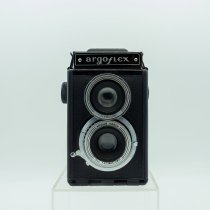
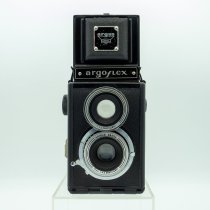
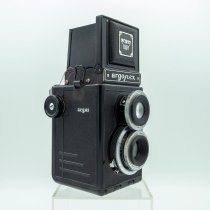
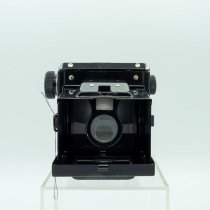
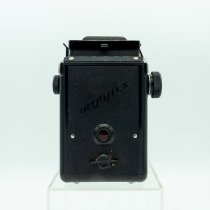
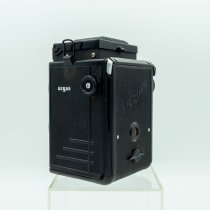
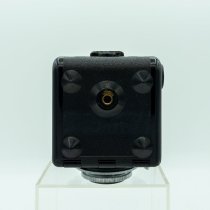
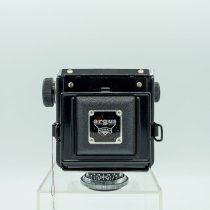
The Argoflex Model E provided features without frills. It wasn't as fancy as other models during that time, but it was well-designed and constructed and could produce excellent results, at least for amateur photographers. The Argoflex E followed in the footsteps of another high-quality, full-featured, and expensive German camera, the Voigtlander Focusing Brilliant, from which Argus echoed the focusing mechanism and nameplate design ideas. The nameplates on both cameras are thin painted metal strips that are riveted onto the camera below the viewing hood. The focusing mechanism is the most important similarity. Virtually all twin-lens reflex cameras that were capable of being focused used a rack and pinion mechanism that moved the entire front standards holding both lenses in and out. On the Fothflex, only the lenses moved in and out. Only the Focusing Brilliant used a twin gear mechanism to move both the viewing and taking lenses. Every effort was made to keep manufacturing costs low. The body was molded in phenolic resin. Film transport was accomplished by simply turning the wind knob on the right side of the camera and watching for the number of exposure to appear in the red window on the back. There was nothing automatic or semi-automatic about the procedure as there was in the high-quality German TLRs of the day. The viewing screen was protected by a metal self-erecting hood that held a folding magnifying lens for critical focus. A window in the front section of the hood could be folded down to operate as a sports finder for eye-level viewing. The Argus Varex taking lens was a color-corrected anastigmat triplet of 75mm focal length and maximum f:4.5 lens opening. The iris diaphragm closed down to f:18 with intermediate markings of f:6.3, 9, and 12.7. The viewing lens was matched 75mm f:4.5 anastigmat. The two lenses were coupled by geared teeth that let them move in unison for focusing. The rim-set shutter, made by Wollensak, was a between-the-lens five-speed model ranging from 1/10 to 1/2000 second, plus B and T. It was self-cocking. There was provision for using a cable release, but no double exposure prevention mechanism. The pre-war model used either 120 and 620 size film to produce twelve 2-1/4 inch square negatives per roll. This variant had a small spindle knob on the left side of the camera. |
Classification |
Twin Lens Reflex |